CRS TMT Bars for Coastal Construction in Tamil Nadu: Why Standard Steel Isn't Enough
Introduction: The Coastal Corrosion Challenge in Tamil Nadu
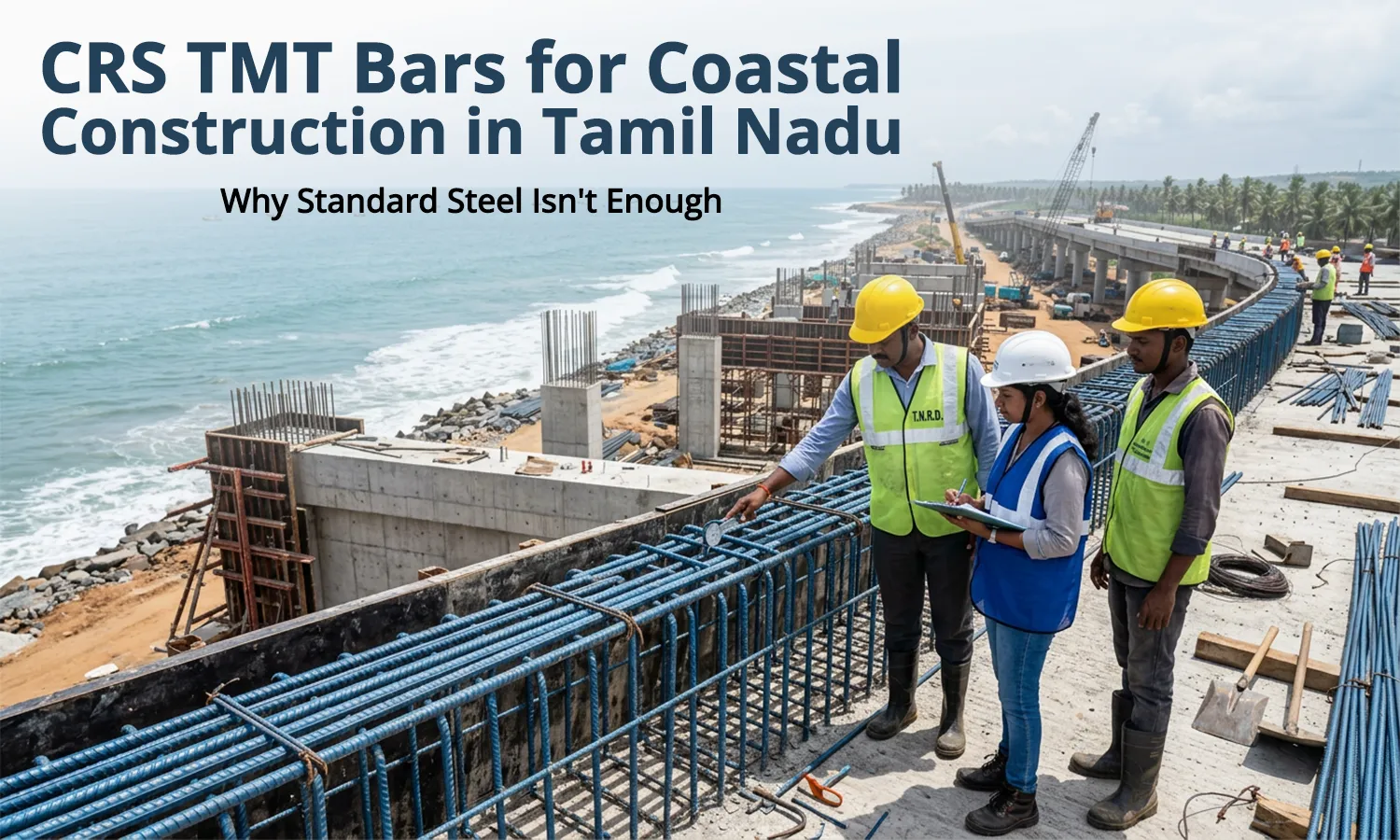
Tamil Nadu has over 1,076 km of coastline, the second-longest of any Indian state. From Chennai to Kanyakumari, millions of residential and commercial buildings stand within 1–10 kilometres of the sea. Every one of these buildings faces an enemy that concrete tries to hide but cannot fully stop: chloride-induced corrosion of reinforcement steel.
This guide explains the science of coastal corrosion, why standard TMT bars, even Fe 550D, are not adequate for coastal Tamil Nadu construction, and what CRS (Corrosion Resistant Steel) TMT bars are engineered to do differently.
Why Steel Corrodes Faster Near the Coast
The Chloride Attack Mechanism
Seawater, coastal winds, and sea spray carry sodium chloride (NaCl) into the atmosphere for distances of 1–5 km from the shoreline (and even further during strong monsoon winds or cyclones). This airborne chloride settles on concrete surfaces and, over time, penetrates through concrete pores and micro-cracks until it reaches the steel reinforcement embedded within.
When the chloride concentration at the steel surface exceeds a threshold (approximately 0.4% by weight of cement in IS 456 terms), it breaks down the passive protective oxide layer on the steel surface, triggering active corrosion. Rusting steel expands to approximately 3–7 times its original volume, generating tensile stress within the concrete cover that causes concrete cracking and spalling, a phenomenon known as chloride-induced delamination.
How Long Does It Take?
| Distance from Sea | Chloride Penetration Rate | Approx. Time to Depassivation | Risk Level |
|---|---|---|---|
| < 500 metres | Very High | 8–15 years (standard TMT) | Extreme |
| 500m – 2 km | High | 15–25 years (standard TMT) | Very High |
| 2 km – 5 km | Moderate | 25–40 years (standard TMT) | High |
| 5 km – 10 km | Low-Moderate | 40–60 years (standard TMT) | Moderate |
| > 10 km | Ambient | 60+ years (standard TMT within design life) | Low |
[Table 1] Indicative chloride attack timelines for standard TMT bars in Tamil Nadu coastal zones. Time to depassivation = time for chloride to break steel's passive oxide layer and initiate active corrosion. Actual timelines vary with concrete quality, cover depth, and exposure severity.
What is CRS TMT Bar? — The CRS Full Form and Technology
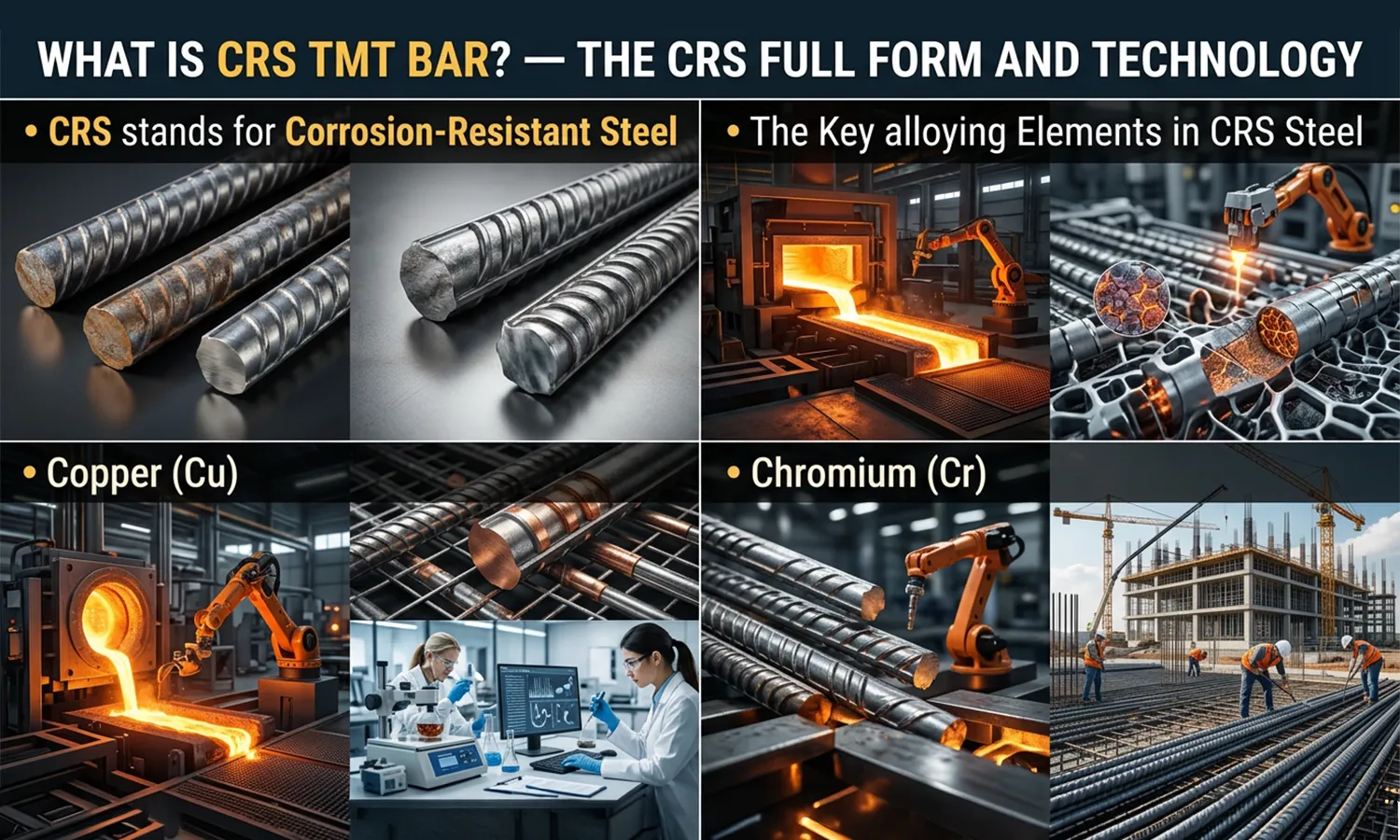
CRS stands for Corrosion-Resistant Steel. CRS TMT bars are manufactured from steel billets with a carefully controlled alloy composition that significantly enhances resistance to chloride-induced corrosion without sacrificing yield strength, ductility, or weldability.
The Key alloying Elements in CRS Steel
- - Copper (Cu): Forms a dense, adherent rust layer (patina) on the steel surface that acts as a barrier against further chloride attack.
- - Chromium (Cr): Strengthens the passive oxide layer, slowing its breakdown in chloride environments. Works synergistically with copper.
CRS vs Standard Fe 550D — Performance Comparison
| Property | Fe 550D | Fe 550D CRS | Difference |
|---|---|---|---|
| Corrosion resistance | Baseline | 2–3× higher than standard | Critical for coastal use |
| Yield Strength | 550 N/mm² (min) | 550 N/mm² (min) | No sacrifice in strength |
| Elongation % | 14.5% (min) | 14.5% (min) | Same ductility |
| Chromium + Copper % | - | 0.040% (min) | Enhances corrosion resistance for coastal environments |
| Weldability (CE) | as per IS 1786 specified limits | as per IS 1786 specified limits | Same weldability |
| BIS Compliance | IS 1786:2008 | IS 1786:2008 (same standard) | CRS is a superset, not different spec |
| Premium over Fe 550D | — | ₹3–8 per kg | Recoverable through lifecycle savings |
| Design Life (coastal) | 20–35 years (coastal) | 50–80 years (coastal) | 40+ year extension typical |
[Table 2] CRS Fe 550D vs standard Fe 550D — performance comparison for Tamil Nadu coastal construction
Which Tamil Nadu Districts Require CRS TMT Bars?
As a practical guideline, CRS TMT bars are strongly recommended for construction within 5 km of the coast in the following districts:
- - Chennai, Tiruvallur, Kancheepuram, Villupuram — North Tamil Nadu coast
- - Cuddalore, Nagapattinam, Thanjavur (coastal taluks) — Cauvery delta coast
- - Pudukkottai (coastal taluks), Ramanathapuram, Thoothukudi — Gulf of Mannar and Palk Strait
- - Tirunelveli (coastal taluks), Kanyakumari — Southern tip
For projects 5–10 km from the coast in high-exposure areas (elevated, exposed sites; near industrial ports), consult a corrosion engineer or specify CRS as a precautionary measure.
Q: How much does CRS TMT bar cost more than standard Fe 550D?
A: CRS TMT bars typically cost ₹3–8 per kg more than equivalent standard Fe 550D bars. On a typical 10-tonne residential project, this represents an additional investment of ₹30,000–₹80,000. Against a potential future cost of ₹5–15 lakh for concrete rehabilitation or structural repair due to corrosion-induced damage, the CRS premium is a highly rational investment.
Q: Is CRS TMT bar available in all standard diameters?
A: Yes. CRS TMT bars are available in standard diameters from 8mm to 32mm, covering all residential and commercial construction requirements. Availability in all diameters may vary by manufacturer. Arun Plus TMT supplies CRS-grade bars in 8mm through 25mm. Contact us for 32mm CRS availability on specific project quantities.
Protect Your Coastal Tamil Nadu Home with Arun Plus TMT CRS Bars CRS Fe 550D available in 8mm–25mm | BIS-certified | Coastal construction expertise Enquire About CRS TMT Bars — arunplustmt.com/contact
Building something that must last?
Arun Plus TMT delivers high-strength, corrosion-resistant bars trusted across Tamil Nadu.
Get a Quote →