Fe 550D TMT Bar: A Complete Guide for Indian Construction (2026)
The Grade Question Every Indian Builder Asks
Walk into any steel dealer in Tamil Nadu, and you will face this question: “Do you want 500D or 550D?” Most buyers either follow the dealer’s recommendation, pick the cheaper option, or simply ask for “the stronger one.” None of these approaches is correct. The right grade depends on your structure type, floor count, seismic zone, and what your structural engineer has specified.
This guide explains the key properties of Fe 550D TMT bars so you can make an informed decision for your construction projects.
Fe 550D: The Technical Specifications
| Property | Fe 550D | What It Means Practically |
|---|---|---|
| Minimum Yield Strength (0.2% proof stress) | 550 N/mm² | Can carry higher loads per unit area |
| Minimum Ultimate Tensile Strength (UTS) | 600 N/mm² | Higher load-bearing capacity |
| Minimum UTS/YS Ratio | 1.08 | Ensures controlled deformation before failure |
| Minimum % Elongation | 14.5% | Provides required ductility for structural safety |
| % Total Elongation at Max Force (Agt) | ≥ 5% | Meets ductile performance requirements |
| Max Carbon % | 0.25 | Controls strength and hardness while maintaining weldability and ductility |
| Max Sulphur % | 0.040 | Better chemical control and durability |
| Max Phosphorus % | 0.040 | Improves corrosion resistance but is controlled to avoid brittleness |
| Max Carbon Equivalent (CE) | 0.61 | Suitable for welding within IS limits |
| Recommended Seismic Use | Zones II–V | Suitable for earthquake-resistant construction |
[Table 1] IS 1786:2008 mechanical and chemical properties — Fe 550D
The Critical Insight: Strength and Ductility in Fe 550D
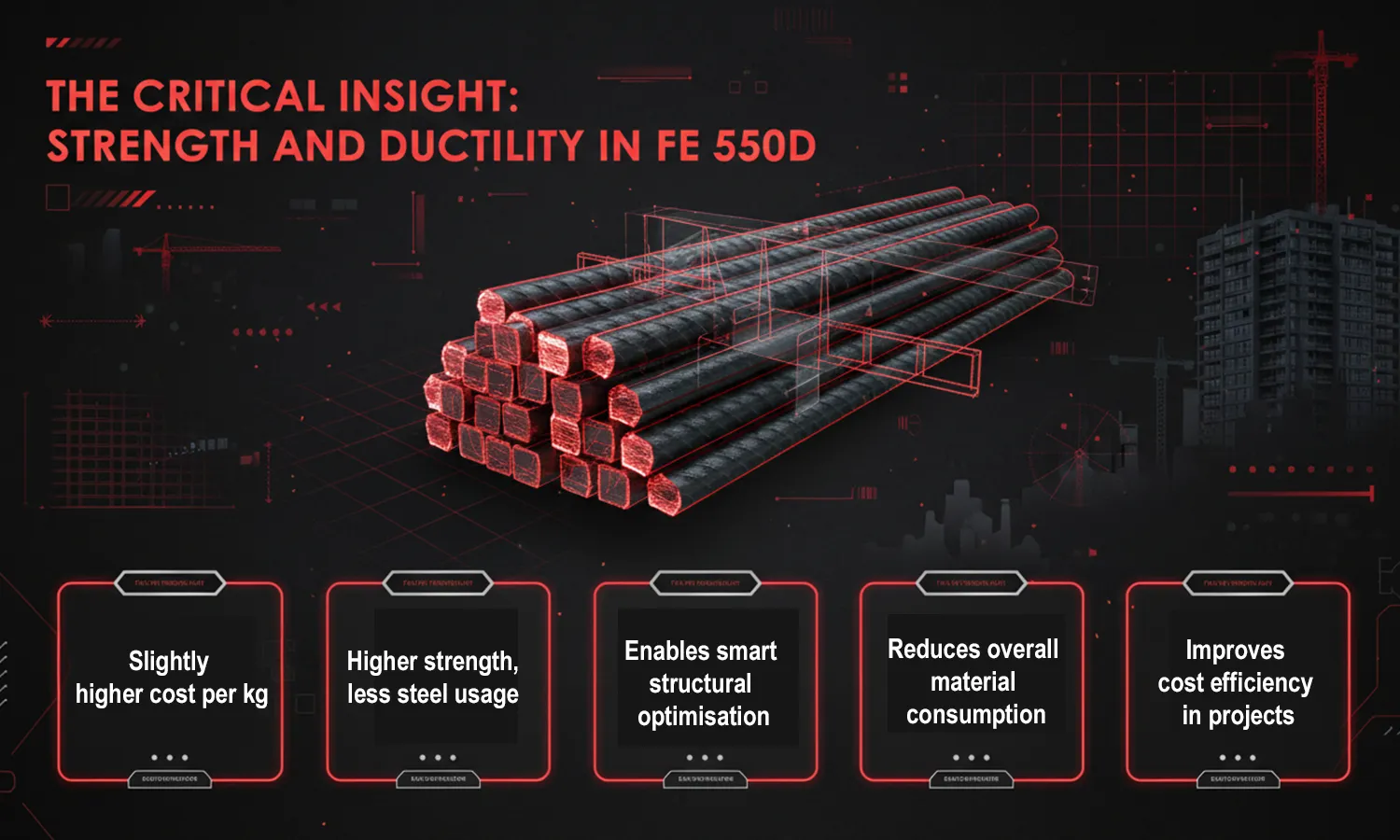
As per IS 1786, Fe 550D is defined by its higher yield strength of 550 N/mm², making it suitable for structures with greater load demands.
While standard specifications define elongation at 14.5%, Arun Plus TMT manufactures Fe 550D with improved elongation performance, ensuring both strength and reliable ductility for structural applications. This enables structures to handle higher loads while maintaining the deformation capacity required for safety.
When Should You Use Fe 550D TMT Bars?
| Application | Recommended Grade | Reason |
|---|---|---|
| Residential construction | Fe 550D | Balanced strength and improved elongation for structural safety |
| Multi-storey buildings | Fe 550D | Higher load-bearing capacity for vertical structures |
| Infrastructure projects | Fe 550D | Designed for heavy-load and critical applications |
| Coastal construction (Tamil Nadu) | Fe 550D CRS | Corrosion-resistant alloying elements improve durability |
| Foundations and footings | Fe 550D | Suitable for high stress and load transfer zones |
| RCC slabs (residential) | Fe 550D | Consistent performance for standard structural loads |
[Table 2] Application-based usage of Fe 550D TMT bars — always follow structural engineer recommendations
Cost Consideration: Is Fe 550D Worth It?
Fe 550D may have a slightly higher price per kg compared to lower grades. However, due to its higher strength, it allows optimisation in steel quantity depending on structural design. For larger projects, this can help balance overall material consumption and cost efficiency.
Conclusion - Strength Backed by Sustainable Manufacturing
Fe 550D TMT bars offer the strength and reliability required for modern construction, especially when supported by consistent manufacturing quality and performance standards.
Arun Plus TMT is also certified with a 5-star Green Steel rating by the National Institute of Secondary Steel Technology (under the Ministry of Steel), reflecting its commitment to low-emission and responsible steel production. This ensures that your construction is not only structurally sound but also aligned with sustainable building practices.
Q: Can Fe 550D be used across all structural members?
A: Yes, Fe 550D is widely used across structural elements such as slabs, beams, columns, and foundations. However, final specifications should always be based on structural design and engineering requirements.
Q: Is Fe 550D suitable for earthquake-resistant construction?
A: Yes. Fe 550D falls under the “D” category as per IS 1786, which ensures higher ductility, controlled elongation, and better performance under seismic conditions.
Q: What does ‘D’ mean in Fe 550D?
A: ‘D’ stands for ductile. The D designation under IS 1786 imposes stricter requirements on elongation, UTS/YS ratio, and chemical composition, making these bars suitable for earthquake-resistant construction.
Order Fe 550D TMT Bars from Arun Plus TMT BIS-certified | In-house quality lab | Full MTCs | Delivery across Tamil Nadu 🛒 View Product Range — arunplustmt.com/products
Building something that must last?
Arun Plus TMT delivers high-strength, corrosion-resistant bars trusted across Tamil Nadu.
Get a Quote →