How to Calculate Steel for Slab: The Definitive Guide for Indian Construction
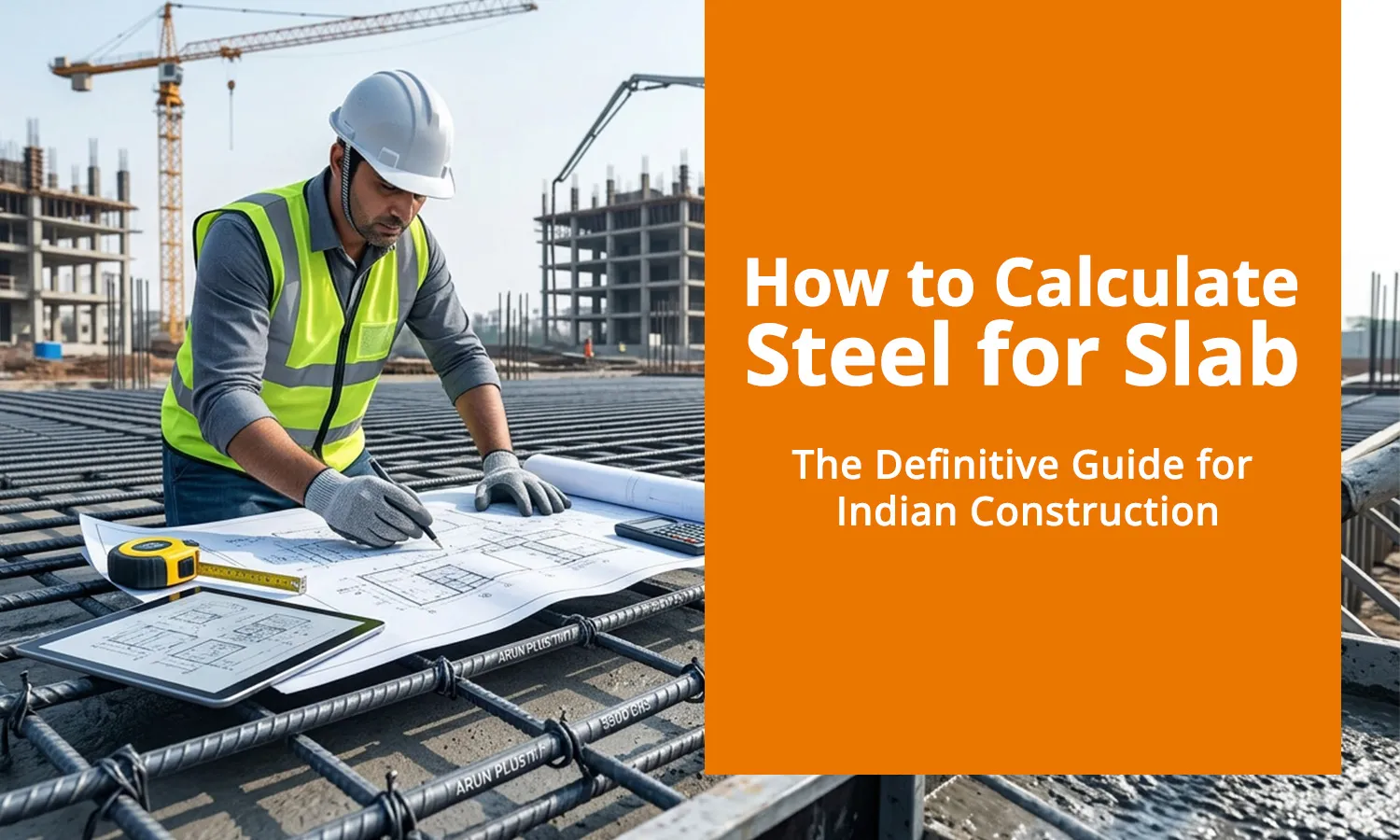
Every civil engineer in India remembers the panic of standing on a sloping plot with a homeowner asking, “Sir, how much steel will we need for the slab?” The answer most contractors give, “around 5 kg per square foot”, is correct to within 20 % and wrong by enough to derail a budget. Knowing how to calculate steel for a slab properly is the difference between an estimate you can defend and a number you have to apologise for at the end of the month. The methodology is straightforward, the principles are unchanging, and the formulas have not moved in fifty years. Here is the method used by structural engineers from Chennai to Kochi, refined to a practical workflow you can apply to any RCC slab project.
The 1% thumb rule and where it comes from
For residential RCC slabs, steel typically constitutes about 1% of concrete volume by volume, meaning a 1 cubic metre slab contains roughly 0.01 cubic metres of steel. With steel density at 7,850 kg/m³, that works out to ~78.5 kg of steel per cubic metre of concrete. This is the “1% rule” every quantity surveyor in India quotes. It is a budgeting tool, not a design tool. The actual percentage varies from 0.6% (lightly loaded one-way slabs) to 1.5% (heavily loaded two-way slabs with cantilevers). For initial costing on standard residential work, 1% is the conservative number to use.
The formula and worked example
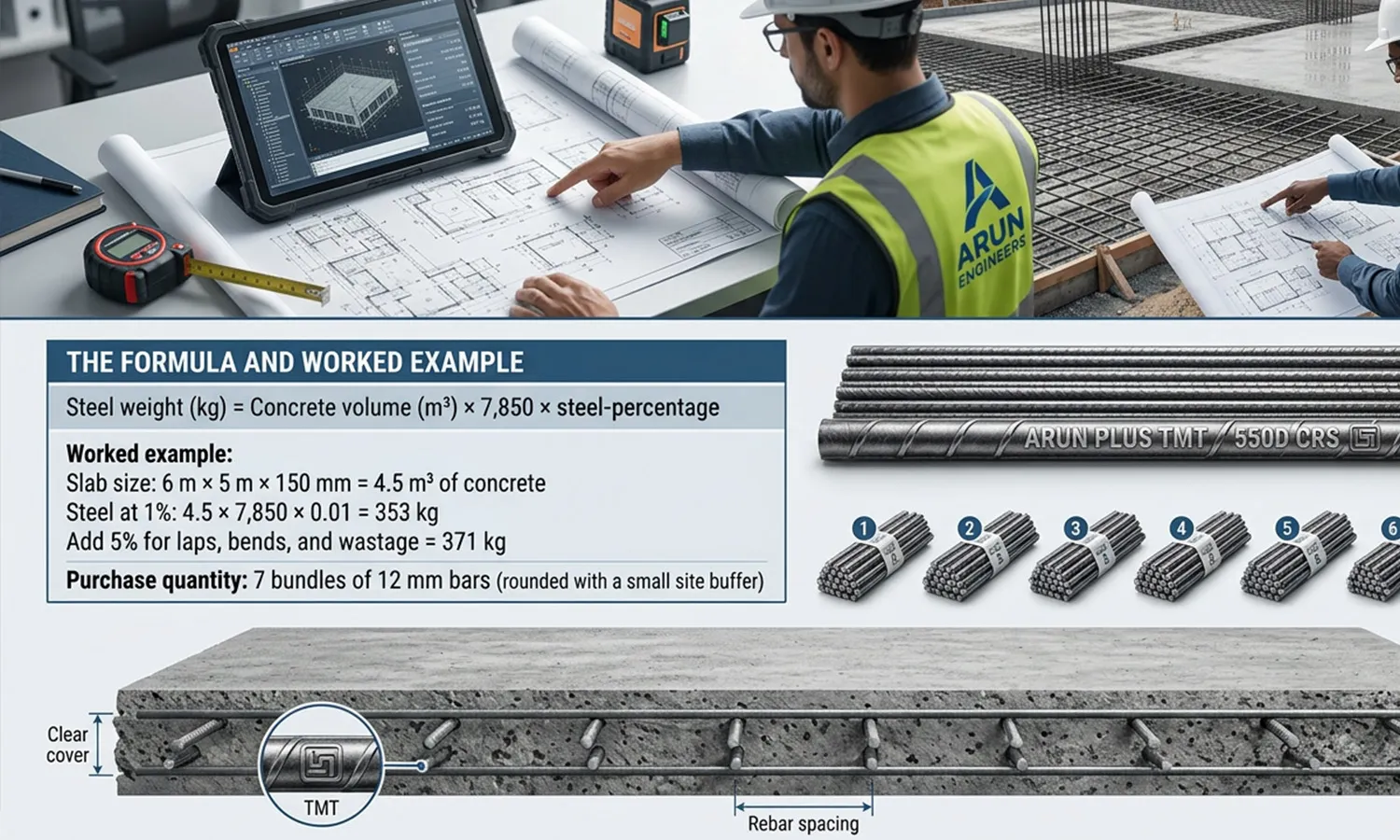
Steel weight (kg) = Concrete volume (m³) × 7,850 × steel-percentage
Worked example:
A 6 m × 5 m slab with 150 mm thickness equals 4.5 m³ of concrete.
At 1%, that’s 4.5 × 7,850 × 0.01 = 353 kg of steel.
Add 5% for laps, bends and wastage, and your buy quantity becomes 371 kg.
Round up to the nearest standard bundle weight for 12mm bars, and your purchase order settles at 7 bundles with a small buffer for site-level adjustments.
This is the workflow your structural engineer should follow while calculating steel for slabs before placing the dealer order.
How many kg of steel per sqft slab, the per-square-foot rule
For Indian residential RCC slabs, plan 4.5 to 5.0 kg of steel per square foot of built-up area. Commercial RCC slabs typically range between 5.0 and 5.5 kg per sqft depending on span, loading and slab thickness.
Steel quantity thumb rule
Steel required (kg) = Built-up area (sqft) × Steel factor (kg/sqft)
For example:
1,000 sqft × 4.5 to 5.0 kg/sqft = 4,500 to 5,000 kg of steel
Coastal Tamil Nadu and Kerala projects exposed to cyclonic loading usually move toward the higher end of the range. The final steel quantity depends on slab thickness, span, live load, reinforcement detailing and structural design.
Slab thickness, span and steel grade are the three variables that move the number
Slab thickness, span and steel grade are the three variables that influence steel quantity. Higher-strength grades such as Fe 550D can help optimise steel quantity depending on slab design, span and loading conditions. Slab thickness also affects reinforcement requirements. A 100mm slab behaves differently from a 200mm slab under the same loading conditions.
Two-way slabs, where both spans are similar, distribute load in both directions and generally use steel more efficiently than one-way slabs of the same area. For accurate quantity estimation, the structural engineer’s Bar Bending Schedule remains the primary reference. For preliminary budgeting, the per-square-foot thumb rule provides a practical estimate.
Frequently Asked Questions
Q1. Is the 1% rule accurate for all slabs?
It is a budgeting estimate. Actual steel varies from 0.6% (light loading) to 1.5% (heavy loading with cantilevers). Use BBS for design accuracy.
Q2. How many kg of steel does a 1,000 sq ft slab need?
Plan 4,500 to 5,000 kg for a residential RCC slab at standard 150 mm thickness.
Q3. Does slab steel quantity change with TMT grade?
Yes. Higher-strength grades such as Fe 550D can help optimise steel quantity depending on structural design and loading requirements.
Q4. How much wastage should I add to my slab steel order?
5% for standard residential, 7% for layouts with cantilevers, balconies and irregular spans.
Building something that must last?
Arun Plus TMT delivers high-strength, corrosion-resistant bars trusted across Tamil Nadu.
Get a Quote →