How to Identify Genuine TMT Bars: A 4-Step Quality Verification Guide (2026)
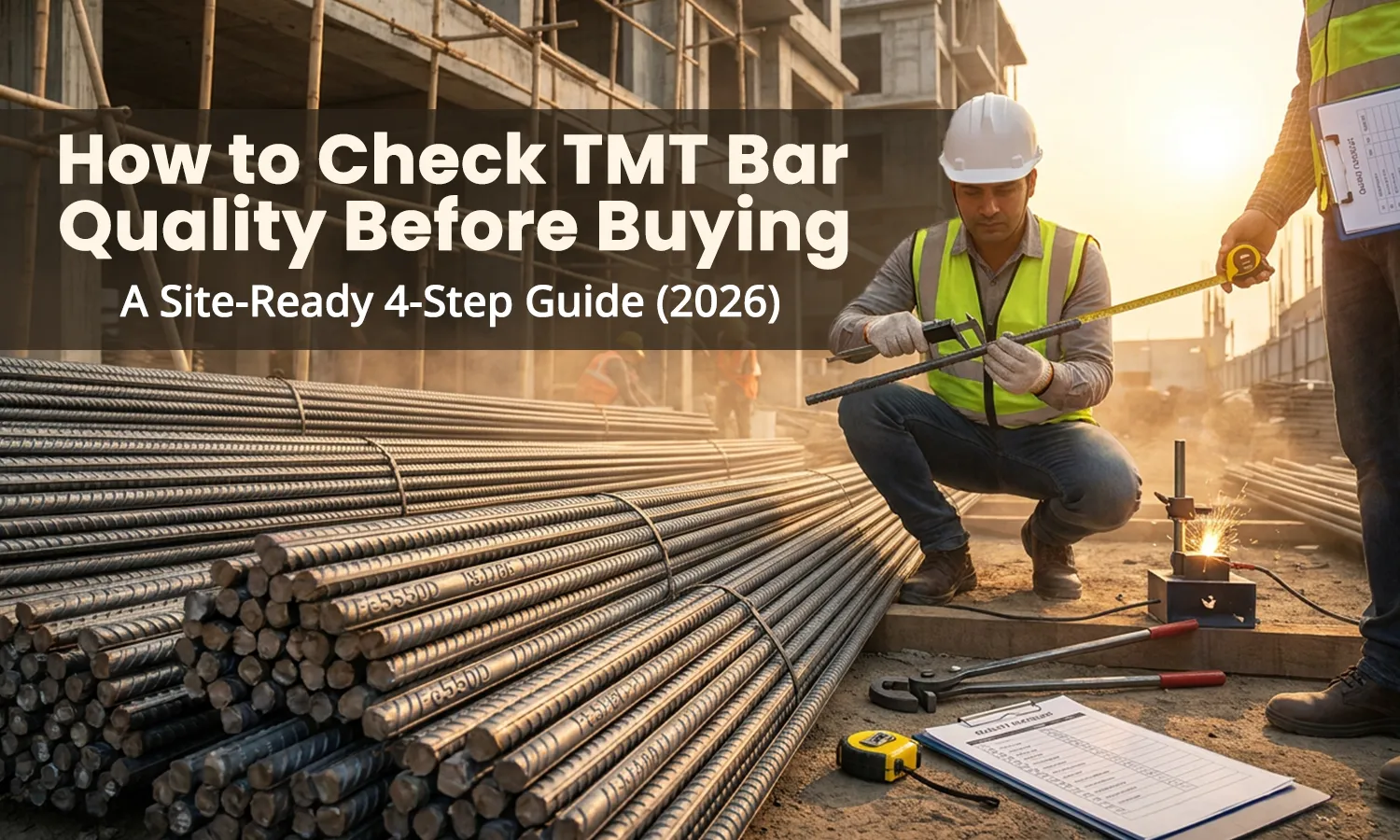
Introduction: The Problem With Substandard TMT Bars
India's construction sector faces a persistent quality problem: counterfeit, non-BIS-compliant, or improperly manufactured TMT bars entering the supply chain through unverified dealers. A 2023 BIS enforcement drive identified non-compliant steel products in multiple states. The risk is not abstract; substandard reinforcement bars inside hardened concrete can result in structures that fail under design loads, earthquake stress, or simply over time due to corrosion.
The good news is that detecting substandard TMT bars before they reach your site is possible with a systematic 4-step verification process.
Step 1: Inspect the BIS ISI Mark (< 5 Minutes)
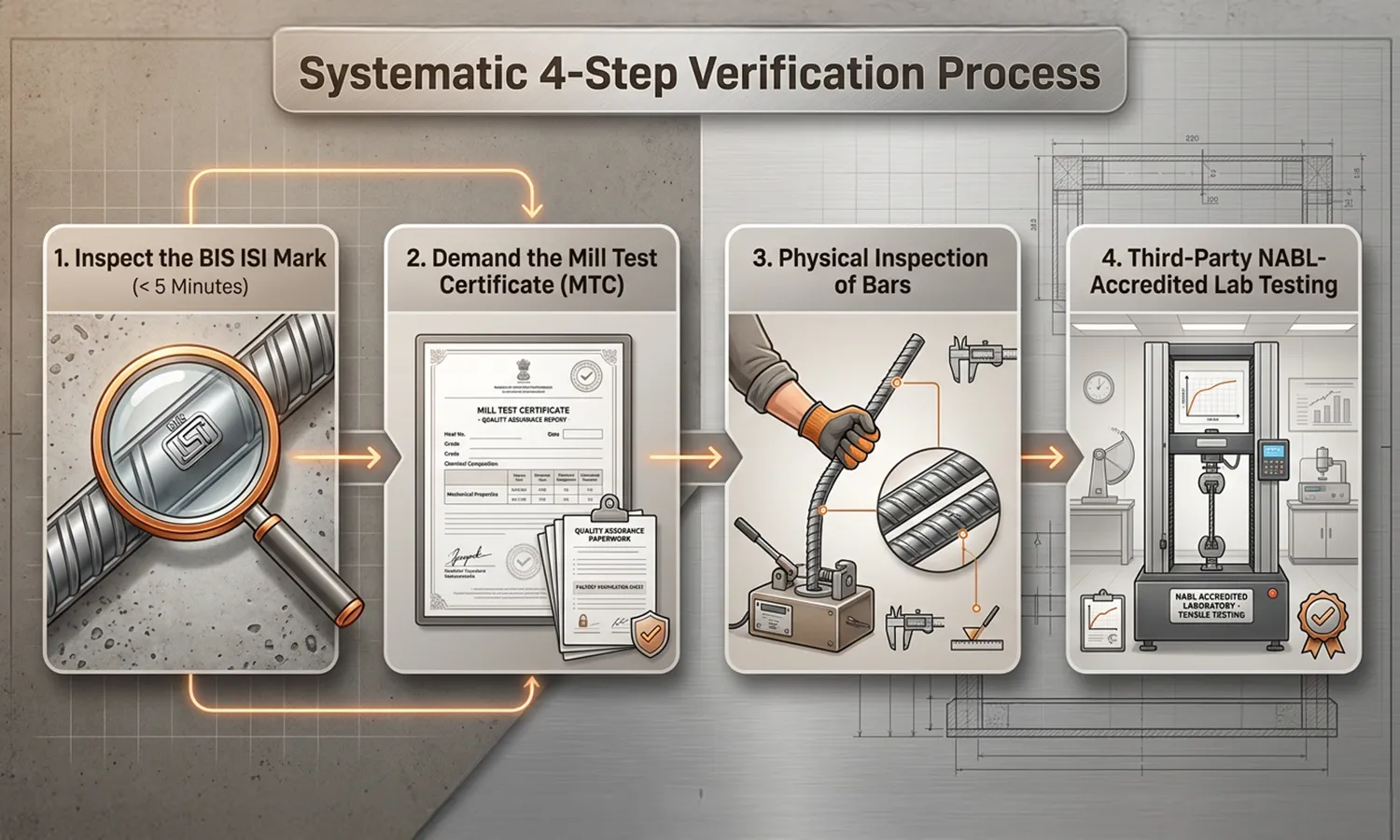
Every BIS-certified TMT bar has the ISI mark rolled directly into its surface rib pattern. This is a physical impression in the steel. Run your finger along the ribs. You should feel the BIS mark imprinted in the steel.
- - Genuine: BIS mark visible and tactile on every bar of the batch
- - Red flag: BIS mark is painted, stickered, or only appears on a bundle tag
- - Action: Cross-verify the manufacturer's BIS licence at bis.gov.in. Search by manufacturer name or licence number
- - Important: BIS certification is mandatory for all TMT bars in India since the Mandatory Certification Order of 2018. Do not use if they do not have a BIS mark.
Step 2: Demand the Mill Test Certificate (MTC)
A Mill Test Certificate (MTC) is issued by the manufacturer for every production heat (batch). It is a document with legal implications under the Sale of Goods Act; it certifies that the tested sample from that batch meets IS 1786 specifications. Legitimate manufacturers produce MTCs without hesitation.
- - What to check on the MTC: Heat/batch number (must match bar bundle tags), Chemical analysis (Carbon, Sulphur, Manganese within IS 1786 limits), Mechanical test results (Yield strength, UTS, and Elongation must meet or exceed minimum grade requirements), IS 1786:2008 compliance declaration, Manufacturer name, date, and authorised signature
- - Red flag: Dealer cannot provide an MTC, or provides an MTC with a different batch number than the delivered bars
- - Action: Retain all MTCs for the project duration, as they are critical documentation for structural completion certificates
Step 3: Physical Inspection of Bars
Before any bar leaves the delivery truck, a site supervisor should physically inspect a representative sample from each bundle:
- - Hold a bar horizontally. A quality bar should not visibly sag under its own weight.
- - Examine ribs: Uniform, well-defined, consistent depth along the full length. Irregular or shallow ribs indicate inconsistent rolling.
- - Check bar ends: Cut cross-sections should be dense and uniform with no visible voids, bubbles, or laminations.
- - Surface condition: Minor surface rust (reddish-brown oxide) is acceptable and does not affect structural performance. However, heavy pitting, flaking, or scale that visibly reduces the bar cross-section is a rejection criterion.
- - Grade markings: The grade (e.g. 'Fe 550D') and manufacturer's designation should be rolled into the bar surface, not handwritten or painted.
Step 4: Third-Party NABL-Accredited Lab Testing
For purchases above 25–50 tonnes, or for projects where structural consequences of failure are severe (hospitals, schools, multi-storey residential), commission third-party testing from a NABL-accredited materials testing laboratory. Specify tests as per IS 1786:2008:
- - Tensile test (yield strength, UTS, elongation, UTS/YS ratio)
- - Bend and rebend test
- - Chemical analysis (carbon equivalent, sulphur)
- - Mass per unit length check (verify weight matches nominal diameter)
Cost: Approximately ₹5,000–₹12,000 per batch test. Turnaround: 3–5 working days. ROI: Potentially prevents the use of substandard steel in a structure that may cost ₹50–₹200 lakh.
Q: Can I check TMT bar quality without a lab?
A: Yes. Basic checks such as BIS mark inspection, MTC verification, and visual inspection can be done on-site. For complete validation of mechanical and chemical properties, laboratory testing is recommended for bulk purchases.
Q: What is the BIS mark on a TMT bar?
A: The BIS (Bureau of Indian Standards) ISI mark is a quality certification impression rolled directly into the TMT bar surface during manufacturing. It indicates the bar has been tested and certified to comply with IS 1786:2008. Bars without a genuine rolled BIS mark are non-compliant and should be rejected regardless of other claims.
Every Arun Plus TMT Bar Comes With Full BIS Certification & MTC In-house quality lab | Batch traceability | IGBC-compliant | Zero-compromise quality Buy With Confidence — arunplustmt.com/products
Building something that must last?
Arun Plus TMT delivers high-strength, corrosion-resistant bars trusted across Tamil Nadu.
Get a Quote →